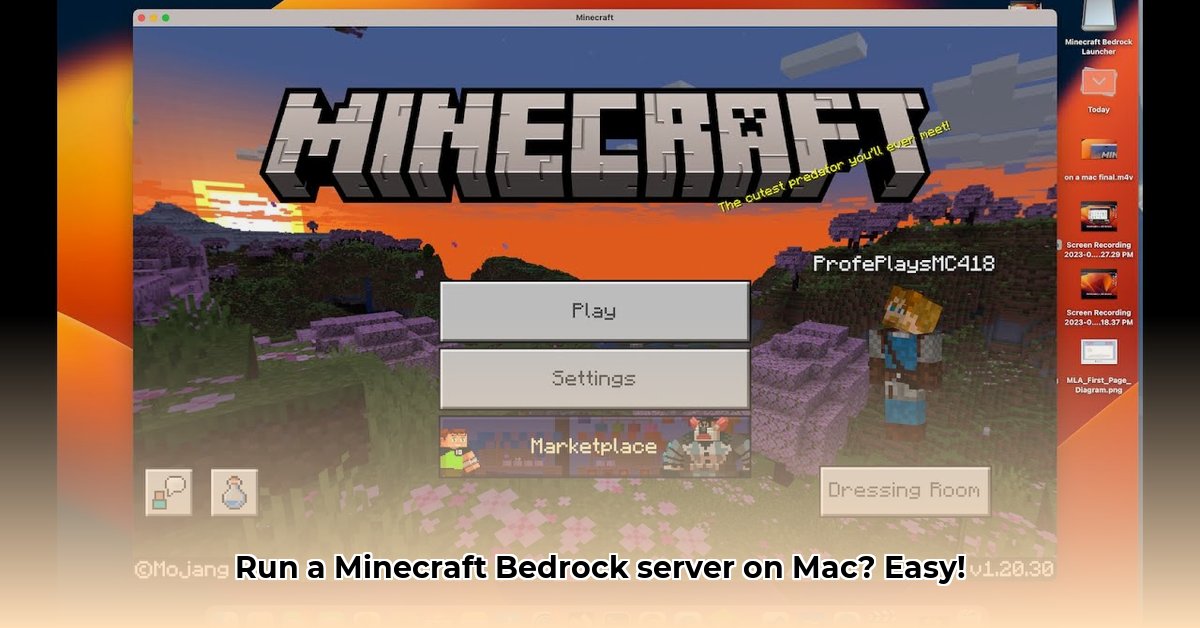
Ready to create your own Minecraft Bedrock world and invite friends? This guide provides a streamlined approach to setting up a Minecraft Bedrock server on your Mac. Even if you're not tech-savvy, we’ll make this an easy process. For more download options, check out the official Bedrock downloads.
Is Your Mac Ready? Checking System Requirements
Before downloading, ensure your Mac meets the minimum requirements for a smooth Minecraft Bedrock server experience. Think of it like checking ingredients before baking a cake; you want the right foundations!
| Component | Minimum Requirement | Recommended | Why it Matters |
|---|---|---|---|
| Processor (CPU) | Intel Core i3 3210 or AMD A8 7600 APU equivalent | Intel Core i5 or better | The CPU handles game processing. A faster CPU means fewer lags. |
| Memory (RAM) | 4 GB | 8 GB or more | RAM is short-term computer memory. More RAM ensures smoother gameplay, especially with many players. |
| Hard Drive Space | 180 MB - 1 GB (depending on world size) | At least 4 GB (for larger worlds and future updates) | Space is needed for server files and the game world. Larger worlds require more space. |
| Operating System | macOS (check Minecraft's site for compatibility) | Latest macOS version | An up-to-date macOS ensures optimal performance and compatibility. |
| Internet Connection | Broadband internet connection | Stable, high-speed connection | A good connection is crucial for uninterrupted player access. |
Have you considered the impact of server load on your Mac's performance? A powerful CPU and ample RAM are crucial for a lag-free experience.
Downloading the Minecraft Bedrock Server: A Step-by-Step Guide
Let's download those server files; it's straightforward.
- Go to the Official Minecraft Website: Open your web browser and navigate to the official Minecraft website. Download links are clearly organized.
- Locate the Bedrock Server Download: Ensure you download the correct version. There's a separate download for the Java Edition. Look for the Bedrock Server for your operating system.
- Download the File: Click the download button (likely a
.zipfile). Save it to a memorable location, such as your Desktop. - Extract the Files: Double-click the
.zipfile to extract the contained files into a new folder. These are needed to set up your server.
Did you know that downloading the correct server version is crucial for avoiding compatibility issues? Double-check this step before proceeding.
Setting Up Your Server: Getting Started
Here's where the server becomes functional.
- Find the Server Files: Open the folder containing the extracted files. You'll find a file named
bedrock-server(or a similar name, depending on the version). - Create a
server.propertiesFile: Before the first server run, you might need to create aserver.propertiesfile. This file controls server settings such as game mode and player limits. Consulting the Minecraft Wiki or online guides can be helpful if needed. - Run the Server: Double-click the
bedrock-serverfile. The initial run generates essential files (this may take a few minutes). The server's output window displays its status and any errors.
What are the key settings within the server.properties file? Understanding these settings is pivotal to customizing your server.
Customizing Your Server: Personalization Options
Now for the fun part: creating your unique server!
- Port Forwarding (For External Players): If you want players outside your local network to join, configure port forwarding on your router. Instructions vary based on your router model, but many online guides provide assistance.
- Adjust Server Settings: The
server.propertiesfile lets you customize game mode (survival, creative, adventure), player limits, cheats, and more. Experiment to find the best settings. - World Generation: Choose your preferred world type – vast ocean, lush jungle, challenging desert, or something unique. Many options exist to create a custom world.
How can you balance server performance with creating a rich and challenging gaming experience for your players? It’s all about the right settings.
Troubleshooting: Addressing Common Problems
Even experienced server administrators encounter issues. Here are some common problems and solutions.
- Server Won't Start: First, verify your Mac meets minimum system requirements and has sufficient disk space. Check the server's output window for error messages.
- Players Can't Connect: Network configuration or port forwarding problems might be at fault. Verify router settings and that your firewall isn't blocking connections.
- Game Crashes: Outdated server software frequently causes crashes. Make sure you're using the latest Bedrock server version.
What resources are available if you encounter problems not covered here? Online Minecraft communities are an incredibly helpful resource.
Launching Your Minecraft World
Congratulations! You’ve set up your Minecraft Bedrock server. Invite friends and explore the custom world you've created. Remember to update regularly for new features and bug fixes to ensure a smooth experience. Enjoy!
What are some best practices for maintaining a stable and engaging Minecraft server for your friends? Regular updates and community engagement are key.
⭐⭐⭐⭐☆ (4.8)
Download via Link 1
Download via Link 2
Last updated: Monday, April 28, 2025